Your Child Can Now Build Almost Anything. That Does Not Mean They Understand It.
DISCOVERING AI: Igniting Human Potential
ByAmy D. Love, Founder of DISCOVERING AI and of the Global FAMILY AI GAME PLAN initiative
This week, Richard Socher and Bryan McCann, the co-founders of You.com, released 35 predictions for 2026. These are not casual observers of the AI landscape. Socher is one of the most cited AI researchers in the world and a former Chief Scientist at Salesforce. McCann’s work in natural language processing helped shape the systems that power today’s generative AI tools.
When people who have built the underlying infrastructure compress a timeline, it signals something important.
One of their predictions was direct: traditional coding will be gone by December. AI will write the code. Humans will manage it.
AI-assisted coding has existed for years. The significance is not the capability. It is the timing.
December.
Not five years from now.This year.
When builders of the technology move that quickly, it means the shift is already operational inside companies. The tools are stable. The productivity gains are measurable. The expectation has changed.
Most families are not raising children who plan to write software for a living.That misses the larger point.
The larger point is this:your child can now create something technical simply by describing what they want built. They can outline an app, a workflow, a tool, or a system, and AI will generate the underlying code.
Creation through description is becoming standard.
That changes the learning equation.
The question is no longer whether children can produce output. They can.
The question is whether they understand what they are producing.
Because capability without competence produces slop.
Harvard Business School researchers are studying what happens when AI becomes embedded in professional environments. The results show clear gains in quality and speed. At the same time, researchers observed a pattern they now call “workslop.”
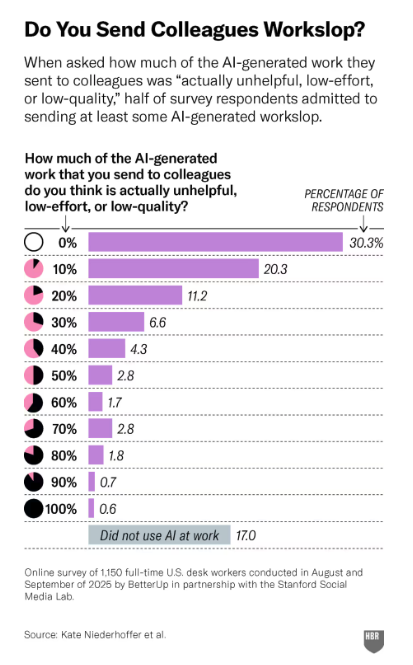
Instead of reducing workload, AI often leads teams to accept more assignments, more revisions, and more simultaneous demands. Acceleration expands expectations.
More concerning is what happens when professionals rely on AI beyond their expertise. When individuals move outside their domain knowledge and trust AI to compensate for gaps, error rates rise sharply. In consulting studies, mistakes increased significantly when professionals left their swim lanes and depended on AI in areas they did not fully understand.
AI generates answers fluently. It does not generate experience.
Without depth, acceleration produces noise.
Return to the December timeline.
If AI writes the code, the value shifts immediately to the person who:
decides what should be built
evaluates whether it works, recognizes weaknesses
anticipates consequences.
Entry-level execution becomes less scarce. High-level judgment becomes more valuable.
This shift is not about coding. It is about supervision, evaluation, and discernment.
Now consider the classroom.
When a student can generate an essay, a math solution, a study guide, or even a functional application by describing what they want, production becomes easy. Evaluation becomes the differentiator.
Can they explain the reasoning behind the answer?
Can they identify limitations?
Can they improve the structure?
Can they recognize when they are operating outside their depth?
If AI replaces productive struggle, completion becomes faster while understanding becomes thinner. If AI extends thinking, learning becomes deeper.
That distinction is developmental.
It is also central to the Six Essential Traits I outline in RAISING ENTREPRENEURS: Preparing Kids for Success in the Age of AI and DISCOVERING AI: A Parent’s Guide to Raising Future-Ready Kids.
These traits are not abstract ideals. They are practical advantages in a world where output is easy and judgment is scarce.
Adaptability matters because tools will continue to evolve quickly, and roles will shift alongside them.
Critical thinking matters because AI produces confident answers that still require scrutiny.
Creativity matters because describing what you want only works when you can envision something worth building.
Emotional intelligence matters because accelerated environments intensify collaboration, accountability, and leadership.
Technological fluency matters because understanding how systems function reduces blind reliance.
Initiative matters because opportunity increasingly belongs to those who can direct tools thoughtfully rather than simply operate them.
Access has expanded. Differentiation has moved upstream.
Judgment is the advantage.
Judgment requires knowledge.
And knowledge requires engagement.
Your child now has unprecedented creative capability at their fingertips. The question is whether that capability rests on a foundation strong enough to support it.
The timeline has accelerated.
Our parenting, teaching, and overall leadership must accelerate with it.
Please share your thoughts:
Where does AI create noise in your work?
And when your child uses AI, are they questioning it or trusting it?
