Mindspark #37: Real, AI, or Not Enough Information?
This week, we are helping our children practice one of the most important skills they need in the Age of AI: knowing when to pause before believing what they see.
For most of our lives, video felt like proof.
Today, a video can look completely real and still be AI-generated, altered, or taken out of context.
At the same time, some real videos are so unusual that people immediately assume they must be fake.
That is what makes this week’s family conversation so important.
How It Works
Step 1: Compare the Bear and Bunny Videos
Watch these 2 videos together:
💠 The bear walking away with a golfer’s clubs
💠 The bunnies jumping on a trampoline
https://www.tiktok.com/@rachelthecatlovers/video/7531584773500751118?lang=en
One video is real.
One is AI-generated.
Before looking up the answer, ask each family member to choose:
💠 Real
💠 AI-generated or manipulated
💠 Not enough information to decide
Then compare your answers.
Ask:
💠 What made one video feel more believable than the other?
💠 Did the movement look natural?
💠 Did the animals interact with their surroundings in a realistic way?
💠 Did the lighting, shadows, background, or camera movement help you decide?
💠 Were you relying on what you saw, who posted it, or what you already know about bears and bunnies?
💠 What else would you need to check before sharing either video?
The goal is not simply to guess correctly.
The goal is to notice how each person decides what feels real.
Step 2: Watch the Soccer Friendship Video
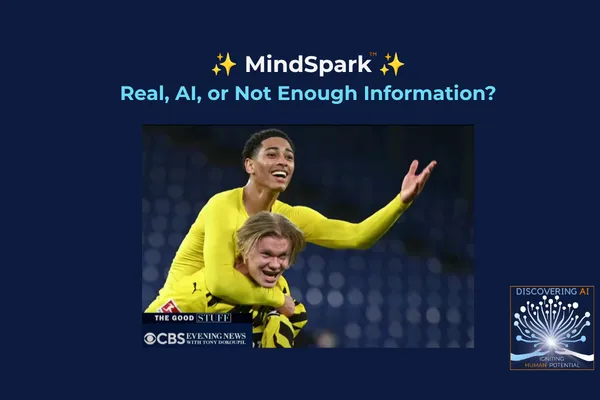
Next, watch this video of soccer stars Erling Haaland and Jude Bellingham:
https://www.instagram.com/reels/DawSWMLCVWJ/
Because we now see so many AI-generated memes, celebrity clips, and fake interactions online, it would be easy to assume that a playful video involving 2 famous athletes had been created or manipulated.
In this case, it was real.
Their team staff actually had them perform the Valentine’s Day skit while they were teammates at Borussia Dortmund.
Talk about this together:
💠 What made the video feel real or fake?
💠 Did knowing the team created it change how you viewed it?
💠 Would you have believed it without knowing the source?
💠 Why are videos involving famous people especially easy to question now?
💠 How can an official team, school, company, or news account help us verify what we are seeing?
This is an important reminder that unusual does not automatically mean artificial.
Sometimes something is simply funny, unexpected, or hard to believe.
Step 3: Go Deeper With InvestigateTV+
For families who want to explore the topic further, watch this InvestigateTV+ report:
The report shows how realistic AI-generated videos can now appear and why many of the visual clues people rely on today may become less useful as the technology improves.
After watching, ask:
💠 Which example was the most convincing?
💠 What warning signs did you notice?
💠 Which warning signs may disappear as AI improves?
💠 Why is checking the source becoming just as important as studying the video itself?
💠 What responsibility do creators have to label AI-generated content?
Why This Matters
The first of the 6 C.R.E.A.T.E. Traits is Critical Thinking and Problem-Solving.
In the Age of AI, Critical Thinking includes knowing how to:
💠 Separate evidence from emotion
💠 Check the original source
💠 Review the date, location, and context
💠 Look for confirmation from other reliable sources
💠 Question content that feels designed to shock, delight, frighten, or anger us
💠 Say, “I do not have enough information yet”
That last response matters.
Our children do not need to make an immediate decision about everything they see.
They can pause.
They can investigate.
They can decide after gathering more information.
Parent Tip
Avoid turning this into a contest to see who can spot the fake.
The best part of this activity is hearing how your child thinks.
You may discover that they trust a video because it looks professional, because it appears on a familiar platform, because a friend shared it, or because the content matches what they already believe.
That gives you a natural opening to talk about sources, emotions, context, and the responsibility that comes with sharing content.
Family Action Step This Week
Finish this sentence together:
“Before our family believes or shares a video, we will ____________________.”
Your family agreement might include:
💠 Check who originally posted it
💠 Look for the full video instead of relying on a short clip
💠 Search for confirmation from 2 reliable sources
💠 Review the date, location, and context
💠 Look for an AI-generated or manipulated-content label
💠 Pause before sharing anything that creates a strong emotional reaction
💠 Ask whether an official organization or trusted source has confirmed it
Add your final agreement to your FAMILY AI GAME PLAN™.
The purpose is not to teach children to distrust everything they see.
The purpose is to help them become thoughtful observers, responsible creators, and confident Critical Thinkers.
Family Extra
Which video fooled your family?
Reply and share how your family completed this sentence:
“Before our family believes or shares a video, we will…”
We would love to hear what you decided together.
#MindSpark #DISCOVERINGAI #FamilyConversations #CriticalThinking #AILiteracy #CreateMoreConsumeLess #worldcup2026
