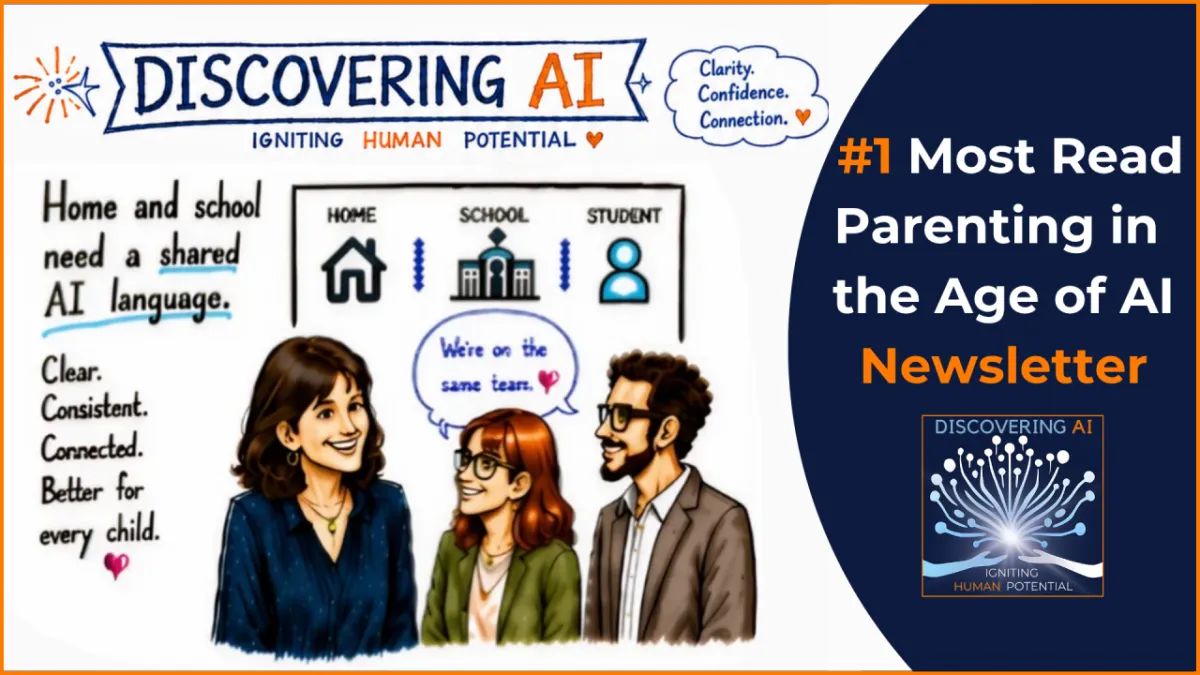
Home and School Need a Shared AI Language
DISCOVERING AI: Igniting Human Potential
By Amy D. Love, Founder of DISCOVERING AI and of the Global FAMILY AI GAME PLAN initiative
The Gap That Must Be Closed
Over the past three weeks, we have covered why AI readiness is no longer optional, why AI literacy is a life skill families can build at home just like driver's ed or internet safety, and why the FAMILY AI GAME PLAN™ gives families a clear framework for values, boundaries, and expectations.
This week, we get into one of the most consequential challenges facing families right now: the growing distance between children learning with AI and children using AI without the values to know the difference. Between recognizing AI as a shortcut that bypasses their thinking, and embracing it as a learning support that strengthens it. Between treating it as just another app, and understanding it as a foundational workplace skill that employers already expect new hires to bring on day one.
That values gap puts families and schools in a genuinely difficult position. Schools are chartered with preparing young people to be productive, contributing members of society. Families are chartered with raising children whose values guide how they show up in the world. AI sits squarely at the intersection of both. And it is why the two cannot afford to speak different languages.
AI is not confined to the classroom. It does not clock out at 3 PM. Children have access to it at any hour, on any device, in any context. Schools play an important role in shaping how AI is used for learning. And the way a child shows up to school thinking about AI, whether as a shortcut, a support, or a skill, will reflect the values their family has already instilled.
How families choose to use AI to augment education, navigate daily life, and prepare for a workplace that already expects AI literacy, those choices need to be grounded in values that start at home. Schools have always taught character alongside academics. Families have always been the first and most enduring influence on how a child approaches the world. With AI, that dynamic does not change. The urgency of getting the shared language right between families and schools simply becomes greater.
That alignment is not happening consistently yet. Stanford Institute for Human-Centered Artificial Intelligence 2026 AI Index found that only half of U.S. middle and high schools have established AI guidelines, and just 6% of teachers say those guidelines are clearly communicated. At the same time, over 80% of students are already using AI for schoolwork, for research, essay editing, and brainstorming. Families and schools are navigating new terrain, often without a shared map.
On the home side, the picture is equally uneven. A recent CRPE survey found that 58% of parents believe AI use on schoolwork counts as cheating unless a teacher explicitly approves it, yet only 14% have had a conversation with their child about what appropriate AI use actually looks like. These numbers are not a criticism of families or schools. They are a reflection of how fast this technology has moved and how much the conversation still needs to catch up.
The opportunity is here. And it belongs to families to lead it.
Why Shared Language Matters
Children take their cues from the trusted adults around them. When a teacher frames AI as a shortcut, a parent sees it as a helpful tool, and another adult says simply "be responsible," children are left to interpret what responsible means entirely on their own, usually under pressure, in the moment, without the context or experience to get it right.
That is not a failure of character. It is a predictable outcome when consistent guidance has not been established.
Consider how long it has taken schools to formally address technology in education. The personal computer arrived in the mid-1980s. Smartphones became ubiquitous in the early 2000s. Today, only 12 U.S. states require even one computer science course to graduate, with West Virginia joining that list just in April 2025. Social media reshaped childhood without a coordinated response from families or schools for years. AI is that challenge, accelerated.
Schools are doing important work. And families cannot wait for institutions to move at institutional speed. The families who navigate this well will be the ones who build shared language at home and bring it to the school conversation, rather than waiting for the school to bring it to them.
More and more school districts are releasing AI guidance that specifically calls on families to initiate and maintain AI conversations at home, discussing personal and school AI use, setting clear expectations, and helping children understand the difference between ethical and unethical use. This is the partnership model that serves kids best.
The Three-Category Framework
Vague phrases like "use AI responsibly" or "do your own work" are too broad to guide real decisions. Children need clarity on what those phrases mean in practice. So do parents. That clarity comes from shared language and a simple framework your family can apply consistently.
At DISCOVERING AI, we structure AI use around three categories that your family can adopt together:
AI is allowed. Your child can use AI independently for this type of task. Think brainstorming, exploring a topic for curiosity, checking understanding, or getting feedback on a draft they have already written.
AI is allowed with guidance. Your child can use AI for this task with a parent or educator involved. This is the middle space, where the tool has real value but the stakes or complexity are high enough that an adult needs to be part of the conversation.
AI is not allowed. This is where AI replaces your child's thinking, hides their true ability, contradicts a teacher's explicit expectations, or involves sharing private information about your child or family. This is not just a rule. It is a value.
When your child says "I had AI help me," these three categories give your family the language to ask the right follow-up: was that allowed, allowed with guidance, or not allowed? That question teaches judgment, not just compliance, and it gives your child a framework they can apply independently as they grow.
Building the Bridge Together
Families do not need to wait for perfect school policies to establish shared language at home. And they do not need to approach schools with frustration. They can approach them as partners, because that is what this moment calls for.
At home, start by asking your child:
"What does your teacher say about using AI for assignments?"
"What do you think counts as real help versus doing the work yourself?"
"When does AI make your learning stronger? When might it get in the way?"
"If you were unsure whether AI was allowed for something, what would you do?"
Then choose three to five family phrases you use consistently. Language that becomes habit becomes judgment. Some that work well
"AI can coach you. It cannot replace you."
"Use AI to understand, not to hide."
"If you cannot explain it, it is not yours yet."
"When in doubt, ask the teacher first."
"Your voice matters more than a perfect answer."
When school is in session, consider asking your child's teacher: "How do you define acceptable AI use in class and for assignments at home?" That question opens a dialogue, signals that your family is engaged, and in many cases gives the teacher a useful opportunity to be clearer than they have been.
Two conversations. A bridge built. That bridge is what your child needs to move between home and school with consistency, confidence, and integrity.
The FAMILY AI GAME PLAN™ Connection
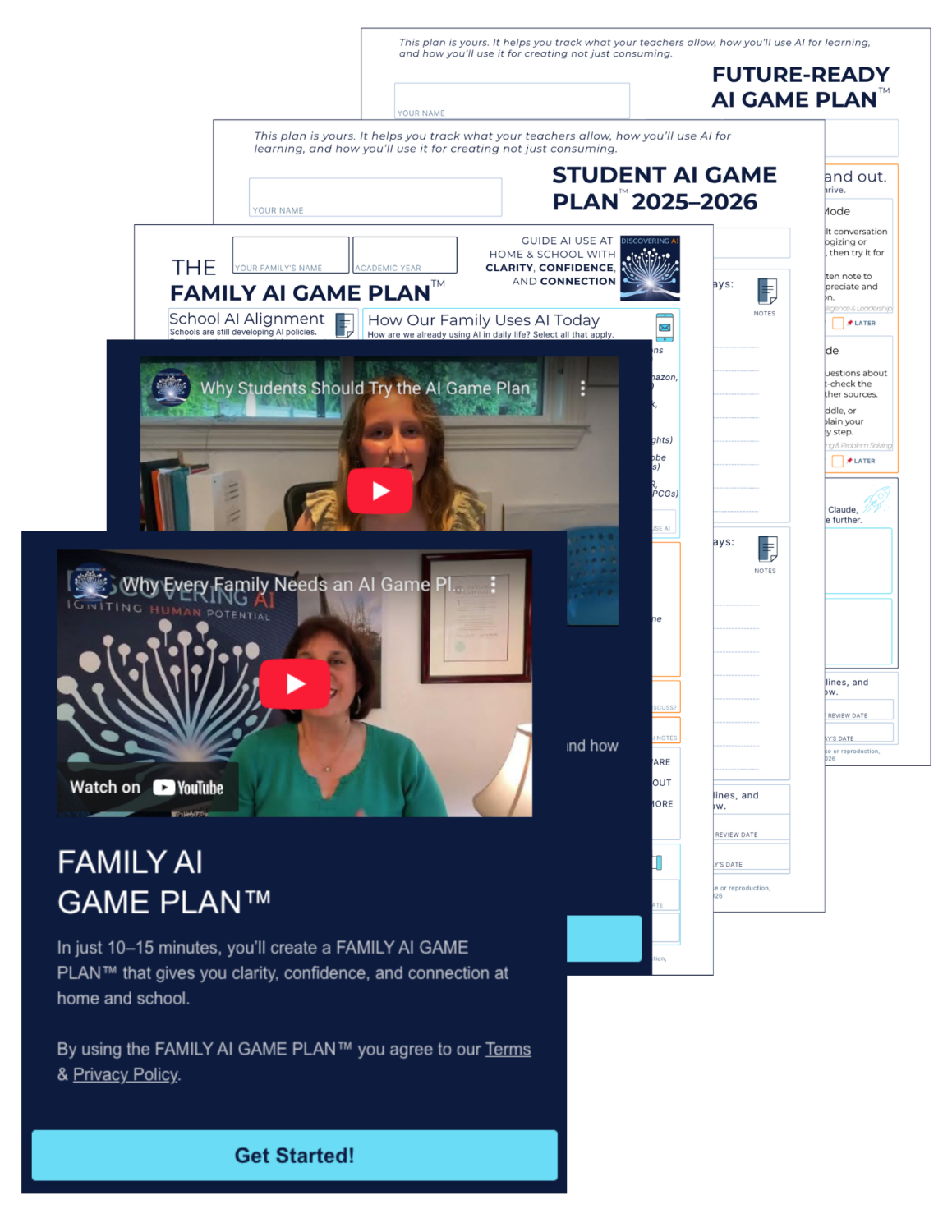
Your FAMILY AI GAME PLAN™ is built for exactly this moment. It helps your family decide which AI tools are appropriate, when oversight is required, what information stays private, and when human judgment must take priority over AI output. It anchors those decisions in your family's values, so the framework your child carries reflects who you are as a family and supports what their school is asking of them.
This is the work of parenting in the Age of AI. Not having every answer. Building shared language before confusion becomes conflict.
With you on this journey,
Amy
