
Before You Buy Any AI Tool for Your Family, Do This First
DISCOVERING AI: Igniting Human Potential
By Amy D. Love, Founder of DISCOVERING AI and of the Global FAMILY AI GAME PLAN initiative
Over the past two weeks, we have looked at two realities that are unfolding simultaneously in most households. AI is already part of your child's world. And it is beginning to shape how they think. Which leads to the question that matters most right now: who is guiding that process?
Many parents assume the answer is schools. The data tells a different story. A spring 2025 survey by the Center for Applied Research in Education found that 96% of families with an elementary-aged child either did not know about any school-communicated AI policy or explicitly reported that their school had communicated nothing at all. Only 22% of students say they have received any guidance on how their school expects them to use AI, and just 12% say anyone has ever explained to them what AI actually is and how it works. Teachers are navigating this in real time as well: fewer than a third report having received training on how to use AI tools effectively, and only 17% say their training covered how to monitor AI systems in a classroom setting. Seven in ten teachers in CDT's research reported that they worry AI is weakening the skills students need to develop. Half of students agreed that using AI in class makes them feel less connected to their teacher.
This is not a failure of schools. It is what happens at the frontier of any technology that moves faster than institutions can adapt to it. By mid-2025, between 28 states + the District of Columbia had issued some form of AI guidance for K-12 schools, and given how quickly the technology is shifting, thoughtful guidance is probably the right posture for now. Locking in rigid policy around a moving target risks getting it wrong in ways that take years to unwind. What works for a literature class may not make sense for a coding elective. What helps a struggling reader may undercut the growth of an advanced writer. The situations are too varied, and the technology too fluid, for any top-down mandate to serve children well in every context.
Into that gap, children are making their own decisions. And most of those decisions are being made without the values-grounded conversation that most families have not yet had.
This is the part that tends to get lost when we talk about AI as a technology story. It is not, at its core, a technology story. It is a parenting story. Most families arrive at the AI question the same way they approach every consumer technology decision: which app has the best reviews, which features matter most, what other parents are using. That framework made sense for choosing a streaming service. It does not fit what is happening here, because AI is not simply a tool you add to a household. It becomes part of how your child encounters difficulty, processes information, and learns to trust or distrust their own thinking. Research published in the Handbook of Children and Screens confirms that parent involvement in children's AI use can promote positive interactions and learning outcomes while meaningfully reducing potential harm. The operative phrase in that sentence is parent involvement, not passive adoption, not hoping the school handles it, but active and intentional engagement with what is actually happening.
The families who are navigating this with the most confidence are not the ones with the most tools. They are the ones who had a conversation first, however imperfect, however brief, about what they believe AI is for, where it supports their child's thinking, and where it starts substituting for it. They are the ones who moved from reacting to deciding. And that shift does not require technical expertise. It requires intention.
Before downloading another app try asking your child one question: how do we want to use AI in our family? Not as a lecture. Not as a rule handed down. As a real conversation, the kind that treats your child as a participant in a decision that will shape how they learn, think, and make choices long after you are not in the room. And with AI, you are very rarely in the room.
This is exactly why we created theFAMILY AI GAME PLAN. Not as a rigid set of rules, and not as a one-size-fits-all answer, because AI does not work that way and neither do families. It is a practical framework designed to help families have this conversation with clarity and confidence, to create a shared language for the gray areas, and to move from reacting to deciding together. Because the families who feel most prepared for what is coming will not be the ones who found the best products first. They will be the ones who paused, talked, and aligned before the tools ever entered the home.
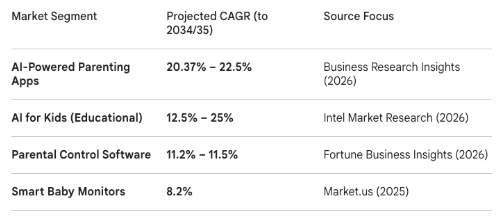
The AI parenting market is projected to grow at more than 22% annually through 2034. The features will keep improving. The choices will keep multiplying. The tools will keep arriving. The families who navigate this best will not be the ones who moved fastest. They will be the ones who paused first.
Start with the conversation. Everything else follows from there.
