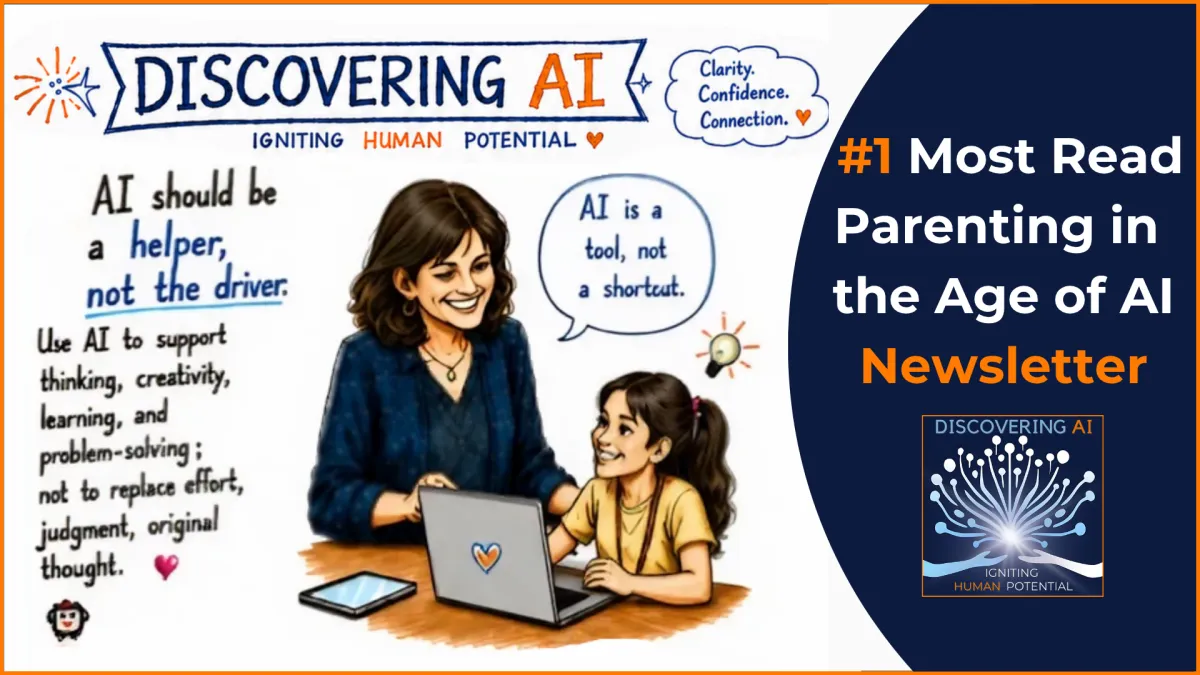
AI Should Be a Helper, Not the Driver
DISCOVERING AI: Igniting Human Potential
By Amy D. Love, Founder of DISCOVERING AI and of the Global FAMILY AI GAME PLAN initiative
Last week we explored the importance of families and schools sharing a common language about AI. This shared framework helps children move between home and school with confidence and integrity. This week, we take the next vital step. Once families agree on when AI use is appropriate, the next question arises: how should children use AI responsibly when it is allowed?
The answer is simple and powerful. AI should be a helper, not the driver. This principle is one of the most clarifying ideas a family can have. It gives children a framework to consider their interactions with AI thoughtfully and avoid habits that weaken learning.
Summer is a crucial time to establish this principle.
With no school structure in place, children find themselves with more unstructured access, no teacher boundaries, and any device at hand to ask for instant answers. That immediacy can encourage handing over the thinking to AI tools. There is no alarm raised in those moments, and something important can be lost. Durable learning requires effort, active processing, and engagement. Quick answers discourage the struggle needed for real understanding.
This is not a new concept for parents. We have always seen that children learn best when they participate actively, whether assembling furniture with us or practicing a sport where they develop instincts through experience. What is new is how quickly and easily AI offers shortcuts at scale. Patterns of dependence can form quietly during unstructured times like summer.
At the same time, AI offers many promising benefits when used well. Research from respected sources shows AI can be a powerful tutor, coach, and feedback partner. Children who use AI to support critical thinking, receive explanations, get guided feedback, or practice at their own pace show improved learning outcomes, motivation, and engagement. This support can be especially valuable for kids who learn differently or want to explore new interests during summer.
What matters fundamentally is whether AI is helping a child think or replacing that thinking. When AI acts as a helper, children remain engaged and responsible for their learning. When AI drives, children become passive observers, and important skills like problem-solving, creativity, independence, and resilience weaken.
This distinction is clear in everyday examples. A helpful AI might ask questions, suggest steps, or prompt a child to explain their reasoning. In contrast, an AI that simply provides answers, writes paragraphs, or completes projects removes learning opportunities.
Many modern AI tools designed for education embrace this helper role. For example, Google’s Guided Learning uses questions and prompts rather than giving answers outright. Some national AI learning assistants do the same by encouraging different ways of thinking. These tools contrast sharply with typing “write my essay” into a chat window.
A crucial question for families is not simply “Did you use AI?” rather “How did AI help you think?” This question invites reflection on the learning process rather than just the finished work. It shows children that their approach matters.
At home, this might look like a child asking AI to explain a concept from a documentary in simple language. Or a young writer requesting feedback from AI before rewriting their story. Coding students might ask AI why their program failed, then fix it themselves. Other examples include quizzing for a competition, exploring multiple ways to understand a word, or organizing project ideas independently.
In all these cases, the child leads the thinking and chooses how to use AI. Compare these with scenarios where AI writes whole stories, completes projects, or provides every answer. That leadership is the key distinction families must highlight.
This principle matters beyond homework or assignments. The habits children develop during unstructured times affect their motivation and confidence. Reaching for AI whenever things get challenging can reduce curiosity and the critical thinking essential for lifelong learning.
The C.R.E.A.T.E. traits children need most critical thinking & problem-solving, resilience & adaptability, emotional intelligence & leadership, AI fluency & digital literacy, thinking creatively, and entrepreneurial mindset and initiative grow through active engagement. AI can support their development when used as a thoughtful aid. Teaching children to use it wisely is the task families face.
Parents do not need to become AI experts. They need a clear family standard. In our home, AI helps us learn and create. It does not replace our thinking. Simple guiding questions help keep kids in charge: “Does this help you understand or do the work for you?” “Can you explain it yourself?” “Are you practicing or avoiding effort?”
A simple phrase can anchor this standard. Something like: “AI can be your helper. You are still the driver.” The driver makes decisions, pays attention, and takes responsibility. The helper provides support and options.
Using this phrase frequently during summer gives children a steady reminder. Summer is a low-pressure moment to get this habit started for the coming school year.
Be on the lookout for this Friday’s MindSpark Activity: Celebrate July 4th with AI Curiosity
This week, invite your child to explore the July 4th holiday with AI.

Choose a fun or open-ended question about Independence Day. For example, “What are some different ways people celebrate July 4th?” or “If you were to invent a new July 4th tradition, what would it be?”
Have your child write or share their own answer first. Then ask an AI tool the same question. Compare the answers together.
Encourage your child to notice what the AI got right, what was surprising, and what ideas might be missing. Finally, have your child explain the holiday or their new tradition in their own words.
This activity builds creativity, critical thinking, and confidence while making AI a helpful partner in discovery.
Summer Break Announcement
OurParenting in the Age of AInewsletter, Facebook Live sessions, and weekly MindSpark activities will take a break for the month of July.
DISCOVERING AI will remain fully engaged throughout the summer, focusing on our C.R.E.A.T.E. camps, as well as our partnerships and individual registrations for the DISCOVERING AI National Back-to-School Event being held on September 23, 2026
We look forward to returning with fresh newsletters and MindSpark family activities starting in August.
Enjoy the summer, stay curious, and see you soon!
The FAMILY AI GAME PLAN™ Connection
Your FAMILY AI GAME PLAN™ is built for exactly this moment. It helps your family decide which AI tools are appropriate, when oversight is required, what information stays private, and when human judgment must take priority over AI output. It anchors those decisions in your family's values, so the framework your child carries reflects who you are as a family and supports what their school is asking of them.

DISCOVERING AI GAME PLANS to guide family discussions and alignment with schools.
DISCOVERING AI GAME PLANS to guide family discussions and alignment with schools.
This is the work of parenting in the Age of AI. Not having every answer. Building shared language before confusion becomes conflict.
With you on this journey,
Amy
***
DISCOVERING AI | igniting human potential discoveringai.org | camps.discoveringai.org
***
𝐃𝐢𝐬𝐜𝐨𝐯𝐞𝐫𝐢𝐧𝐠 𝐀𝐈: Igniting Human Potential
Want to learn more? Follow 💠 Amy Love 💠 on LinkedIn or Facebook and subscribe to the DISCOVERING AI newsletter.
