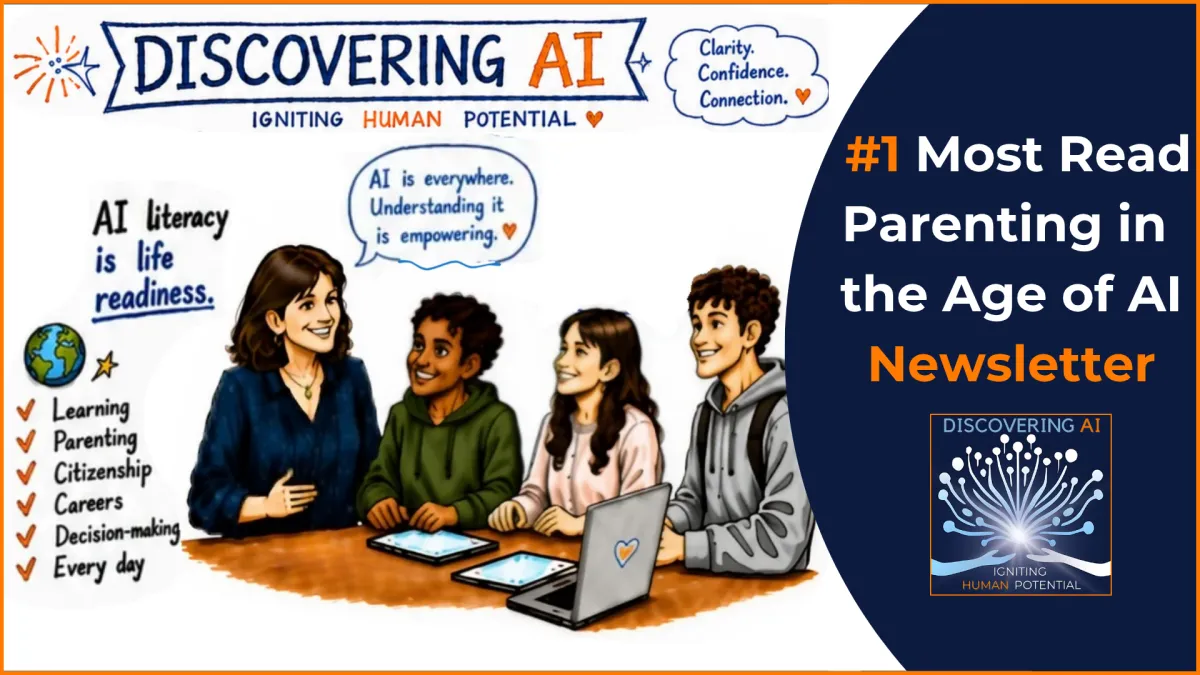
AI Literacy is Life Readiness: The New Essential for Families
DISCOVERING AI: Igniting Human Potential
By Amy D. Love, Founder of DISCOVERING AI and of the Global FAMILY AI GAME PLAN initiative
Parents have always been the first teachers. Long before school begins, families show children how to cross the street, wash their hands, manage their time, and make smart choices online. We teach our children how to stay safe, how to be responsible, and how to think things through before acting. These are life skills: practical, everyday habits that help children thrive both now and in the future.
Now, a new skill is joining this list: AI Literacy. This is not about becoming a technology expert or keeping up with every new app. AI Literacy is the next layer of life readiness, a skill families can approach just like teaching street smarts, digital safety, or learning to drive.
The New Reality: AI is Everywhere
AI is already part of our children’s world. It appears in school assignments, the apps they use, their favorite games, digital recommendations, and even the media they consume. For many families, this can feel like a big shift. The truth is, AI is becoming as much a part of daily life as the internet or smartphones once did.
This does not mean parents need to feel anxious or overwhelmed. Instead, this is a chance to bring the same clarity, confidence, and connection you already use in other areas of parenting. Just as you teach your child to look both ways before crossing the street or to protect their privacy on the internet, you can help them build healthy habits for using AI.
Familiar Ground: Parenting is Already About Readiness
Consider all the ways you prepare your child for independence. You talk about who to trust, how to spot red flags, and when to ask for help. You provide guidance for staying safe online, balancing screen time, and treating others with respect. AI Literacy is simply the next step in this journey.
Some of the best comparisons come from skills you are already teaching
Internet safety:Just as you teach your child not to share personal information online, AI Literacy means talking about privacy, what details should never be shared with a chatbot or app, and how to recognize when something feels off.
Driver’s ed:Children do not start driving alone on day one. You provide supervision, instruction, and plenty of practice before they are ready for independence. AI requires the same approach, as children need guidance, oversight, and clear boundaries before they are trusted to use it independently.
Learning to swim:You do not toss a child into deep water and hope for the best. You teach them the basics, stay close, and help them learn to recognize risks. The same goes for introducing AI. Children need to learn how to “swim” safely before they navigate on their own.
Why AI Literacy is Life Readiness
AI Literacy is not just about using a new tool. It is about understanding how AI works, knowing when to trust it, and developing judgment about what to accept and when to question or double-check. This is what makes it a practical life skill.
National conversations around education and technology are now recognizing that children need protection, and that families have a key role in shaping their digital environment. Guidance for schools and families is moving beyond “how to use AI” toward questions of privacy, fairness, and responsible decision-making.
At its core, AI Literacy means children know:
What AI is and how it shows up in their lives
How to use it safely and responsibly
How to evaluate output, spot bias, and recognize misinformation
When to ask for help or rely on human judgment
The real aim is to strengthen critical thinking in a world where AI is part of the landscape, not to replace thoughtful decision-making with technology.
Bringing Parents Into the Conversation
Families are not expected to become AI experts overnight. The expectation is the same as it always has been: stay involved, ask good questions, and make sure your child has the tools to stay safe, curious, and capable.
There is no need to solve AI for your family all at once. Instead, approach it as you do with other readiness skills. Start small. Use real-life moments, such as an assignment that uses AI, a new app, or a family conversation about news stories, as opportunities to talk about how AI works and how to use it wisely.
You already model this with media use, online safety, and school readiness. AI is simply the next context where your guidance makes an impact. Families build strength when they talk openly about technology, set clear boundaries, and remind children that it is always okay to ask for help.
Empowering Parents: Simple Actions You Can Take
Here are practical ways you can build AI Literacy at home, right alongside the other life skills you teach:
1. Try Our Weekly MindSpark™ ActivitiesEach week, DISCOVERING AI offers aMindSpark activitydesigned to give families practical, easy ways to engage with AI Literacy, discuss values, and grow understanding together. These activities are simple, hands-on, and spark meaningful conversations at home.
2. Ask About School ToolsStart by asking your child’s teacher or school what AI tools are being used in class. This shows your child that you care about their learning environment and helps you stay informed.
3. Talk About PrivacyMake it a family rule that personal information, such as full names, addresses, or private family details, should never be shared with an AI tool or app. Practice saying, “That is not safe to share,” together.
4. Encourage VerificationTeach your child to verify AI-generated answers with another source. If AI helps with homework or a project, ask, “How do you know that is right?” Show them how to check facts and spot mistakes.
5. Discuss Fairness and BiasUse real examples to talk about fairness, bias, and why AI can sound confident even when it is wrong. Ask your child what they think, and discuss how different perspectives can show up in AI answers.
6. Set Family ExpectationsMake it clear that AI should build skills, not replace thinking. Remind your child that using their own brain, and being willing to ask questions, is always more important than letting technology do the work for them.
Ready-to-Use Wording and Family Conversation Starters
If you want to make these ideas part of your family’s daily life, try these phrases:
“AI Literacy is life readiness because children need to learn not just how to use AI, and also how to think with it.”
“Parents already teach children how to navigate the road, the internet, and responsibility. AI is simply the next readiness skill.”
“The goal is not to make children dependent on AI. The focus is to help them stay curious, careful, and capable in a world where AI is everywhere.”
“Just as we teach safety before independence, we need to teach AI Literacy before full use.”
You can ask questions like:
“What do you think this AI tool can and cannot do?”
“Is there anything you would not want to share with an app? Why?”
“How can you tell if an answer is true, or if you should check somewhere else?”
“Why do you think AI sometimes makes mistakes?”
The C.R.E.A.T.E. Connection: Skills that Last
DISCOVERING AI’s C.R.E.A.T.E. approach is all about preparing children for real life, not just the next assignment. By focusing on Critical Thinking, AI Literacy, and Entrepreneurial Mindset, families help children build skills that last: curiosity, resilience, leadership, and the confidence to solve problems in any setting.
The Big Picture: Raising Prepared, Thoughtful, and Capable Children
AI is changing how we learn, create, search, study, and communicate. Parents, students, and teachers all need practical guidance for the Age of AI. The message of DISCOVERING AI is not fear; it is readiness. AI Literacy is not just about technology. The real focus is on raising children who are curious, careful, and ready to thrive in an AI-filled world.
This summer, remember: you do not need to have all the answers. Stay willing to learn, ask good questions, and guide your child as they build the skills to use AI, and every other tool, wisely. If your family is looking for more ways to put these ideas into action, DISCOVERING AI’sC.R.E.A.T.E. Summer Campsoffer a supportive, hands-on environment where children can practice AI Literacy, build confidence, and experience growth, all while having fun.
Together, we can make AI Literacy a natural, empowering part of family life. That is life readiness for the Age of AI.
Amy
𝐃𝐢𝐬𝐜𝐨𝐯𝐞𝐫𝐢𝐧𝐠 𝐀𝐈: Igniting Human Potential
Want to learn more? FollowAmy Loveon LinkedIn orFacebookand subscribe to theDISCOVERING AI newsletter.
