AI Leaders Are Calling for a Pause. Parents Don’t Have That Option
The people building advanced AI are asking for tools to slow its acceleration. Childhood does not come with the same off switch.
It is summer, the season when families hope life will slow down just a little. School assignments pause, schedules loosen, and children have more time to explore, play, travel, scroll, watch, create, and discover.
AI is not taking the summer off.
More than 1,200 employees of frontier AI companies have signed a public statement called Pacing the Frontier. They are asking the U.S. government to support an international effort to develop technical and governance tools that could deliberately pace advanced AI development if progress begins moving faster than society can safely understand or manage.

They are not simply asking everyone to stop building AI. They are raising a more complex question: What happens if AI gains the ability to accelerate its own development before we have the safeguards, coordination, and oversight needed to respond?
When the people closest to the technology say society may need a way to slow it down, parents, educators, and school leaders should pay attention.
Then we need to confront a second reality.
Our children do not get a pause button.
Childhood Is Moving at the Speed of AI
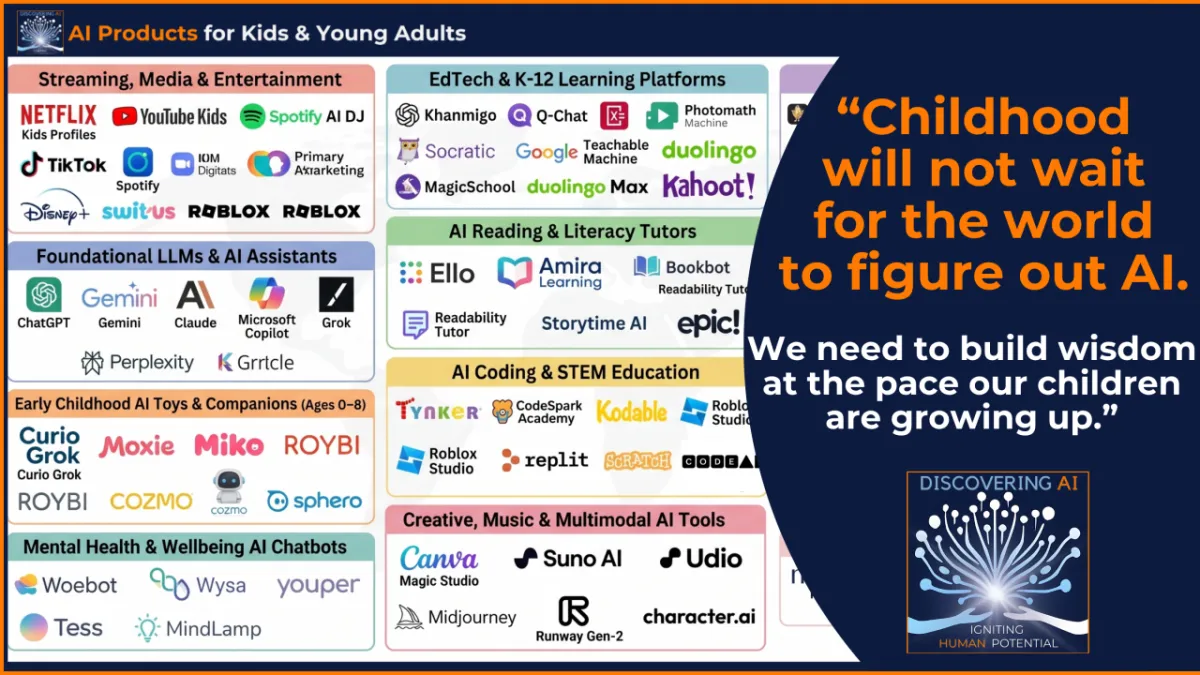
While industry leaders consider how to pace the frontier, children are already growing up inside it.
AI is influencing the videos they are shown, the games they play, the information they find, the images they see, the tools they create with, and the ways they may complete schoolwork. Some children knowingly open ChatGPT, Gemini, or another generative AI tool. Others interact with AI without thinking of it as AI at all.
That distinction matters, especially during summer. Children are not sitting around discussing frontier models or automated AI research. They are simply using technology.

The recommendation that chooses their next video may be powered by AI. So may the photo filter that changes a face, the game character that responds differently to each player, the search result that summarizes an answer, or the tool that creates a song, image, story, or joke.
AI is becoming part of the environment of childhood, often without announcing itself.
That is why parents cannot wait for the technology industry to reach agreement, Congress to pass legislation, or schools to finalize the perfect policy. All of that work matters. None of it stops our children from growing up today.
“Pacing” Has to Mean More Than Slowing the Technology
When I read thePacing the Frontierstatement, I kept thinking about two different clocks.
The first is the technology clock.It measures new models, new capabilities, new products, and new risks.
The second is the childhood clock. It measures judgment, maturity, independence, confidence, identity, and the gradual development of wisdom.
The technology clock is accelerating. The childhood clock cannot be rushed.
A 7-year-old, a 12-year-old, and a 17-year-old should not be expected to interact with AI in the same way. Age matters. Development matters. Context matters. The purpose of the tool matters.
We would never hand children the same responsibilities simply because they all had access to the same car. AI should be no different.
The goal is not to make children afraid of these tools. It is to make sure access does not move faster than judgment.
What Children Need Before the Next School Year
Preparing children for the Age of AI requires more than teaching them how to prompt a chatbot. It requires us to reconsider what learning, mastery, and academic success should look like when students can generate polished work in seconds.
For generations, grades have served as a shorthand for understanding. An A suggested that a student knew the material, had done the work, and was ready to move forward. That connection is becoming less reliable.
In my recentSan Francisco Chronicleopinion piece, “Grade inflation and AI are creating a perfect storm for today’s students,”I explored how grade inflation and AI-assisted work are making it increasingly difficult for parents, teachers, colleges, and even students themselves to know what has actually been learned. A strong grade may reflect genuine mastery. It may also reflect a student’s ability to complete the expected task with significant assistance from AI.

Students do not so much need more A’s in the Age of AI. They need a deeper understanding of what they are learning and the ability to demonstrate mastery in different ways.
Can they explain how they reached an answer? Can they respond when the question changes? Can they work through uncertainty, challenge a confident response, and apply what they know in a different context? Can they sit across from a teacher, college interviewer, employer, or colleague and show that the knowledge and thinking are truly their own?
These capabilities are grounded in the 6 Essential Traits children need to thrive in the Age of AI: adaptability and resilience, critical thinking and problem-solving, creativity and innovation, emotional intelligence and leadership, technological fluency and AI Literacy, and initiative and an entrepreneurial mindset.
Developing these traits requires a different relationship with AI. Children need to learn when it can help them explore an idea and when it could replace the very thinking they need to strengthen. They need to understand that a confident answer can still be wrong and that convenience can carry a cost, including lost practice, weakened skills, exposed personal information, or work that no longer reflects their own understanding.
They also need permission to slow down. Real learning often comes through effort, revision, mistakes, reflection, and the experience of figuring something out without immediately handing the task to a tool. Faster is not always better, especially when the goal is not simply to complete the work. The goal is to build the judgment and capabilities that will matter long after the assignment is finished.
AI can support deeper learning when it acts as a tutor, thought partner, or creative tool. It can also create the appearance of achievement without the substance underneath. As the next school year approaches, our responsibility is not simply to help children produce better answers. It is to help them become more capable thinkers, creators, leaders, and problem-solvers.
That is the kind of mastery that will matter most.
Summer Gives Families Something Valuable: Space
The slower rhythms of summer create an opportunity that can disappear once homework, practices, activities, and school deadlines return.
This does not require a formal AI lesson at the kitchen table. Start with what your child is already doing and adjust the conversation to their age, maturity, and current exposure to AI.
With younger children, notice when technology recommends, changes, or creates something. You might ask, “How do you think it decided to show you that?” The purpose is not to explain every technical detail. It is to help them begin noticing that technology is making choices around them.
With middle school students, try an AI tool together to create something connected to an existing interest. It might be a story, image, travel plan, game idea, or list of questions about a subject they care about. Then talk about what came from the child, what came from the tool, what seems accurate, and what they would change.
With teens, the conversation can go deeper. Talk about the difference between using AI to expand their thinking and using it to avoid thinking. Ask where they believe that line should be drawn and how they would explain their AI use to a teacher, coach, admissions officer, or future employer.
The conversation will look different in every family. The shared goal is simple:Help children notice AI before asking them to navigate it responsibly.
Parents, Students, and Schools Need a Shared Language
Families cannot carry this responsibility alone.
Schools are already confronting questions about academic integrity, personalized learning, AI detection, privacy, bias, and what student work should represent. Teachers need clear expectations. Students need consistency across classes. Parents need enough information to reinforce learning rather than unknowingly undermine it.
Technology companies also need to recognize that the products they release are shaping childhood long before policy catches up.
The answer is not a separate set of rules from every adult and institution in a child’s life. The answer is alignment.
That is why DISCOVERING AI created the free FAMILY AI GAME PLAN™. It helps families establish values, expectations, and practical boundaries at home, then connect those choices to what teachers and schools expect.
Join the National Back-to-School Conversation
OnSeptember 23, 2026, at 5 p.m. PT and 8 p.m. ET, DISCOVERING AI will host the free National Back-to-School FAMILY AI GAME PLAN™ event.
Parents, students, and educators from across the country will come together to understand how AI is changing homework, learning, academic integrity, and the skills children need to thrive. Families will also receive practical guidance for creating shared expectations that align home and school.
The goal is not to give every family the same answer. It is to help every family leave with a plan.
